
The New Look
Design by Rachel Smith
High fashion is more uncanny than ever before.
Ever since the concept of supermodels started to take shape in the mid-20th century, beauty standards have fluctuated as various societal and political influences launched figures into the spotlight. In the 1960s, the British coined the “mod” subculture, with models like Twiggy embodying a rebellious counterculture spirit through pixie cuts and bold eye makeup. By the 80s the term “supermodel” had officially gained traction, and the “Big Six” (Naomi Campbell, Kate Moss, Cindy Crawford, Linda Evangelista, Claudia Schiffer and Christy Turlington) were on the brink of their hegemony, forcing people to start to take the status of the supermodel seriously.
The 90s widened the gap between high fashion and commercial fashion, ushering in the tall, willowy, ethereal look, and the turn of the century molded the quintessential, eurocentric supermodel prototype — think bombshell blowouts; pouty lips; sultry eyes; sculpted hourglass bodies; deep-bronze tans. Then, with the rise of social media and the “Instagram model” in the early/mid-2000s, the fashion world turned their focus to airbrushed figures like Kendall Jenner and the dynamic Hadid duo.
In the recent decade, however, a new look has taken over. A variety of nicknames have surfaced for the trend that is dominating the high fashion industry — some more derogatory than others, such as “alien face” or “strange face” — but it is best encapsulated by the idealization of uniqueness. Though valuing a unique face in a model is not a particularly new practice (Kate Moss, for example, was discovered partially for her unconventional features), never before has it been so ubiquitous in the high fashion world.
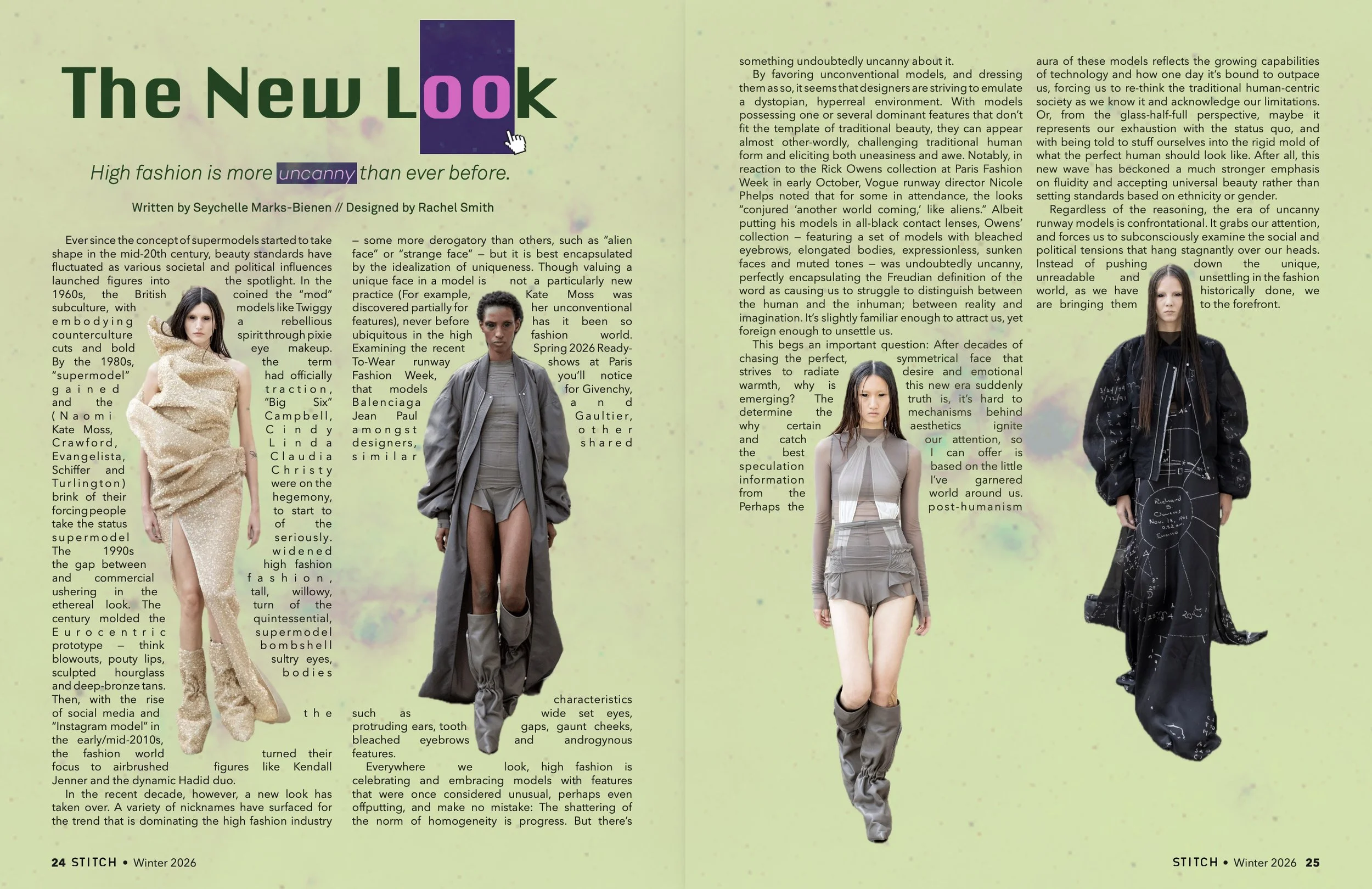
Examining the recent Spring 2026 Ready-To-Wear runway shows at Paris Fashion Week, you’ll notice that models for Givenchy, Balenciaga, Jean Paul Gaultier and many other designers shared similar characteristics, rocking wide set eyes, protruding ears, tooth gaps, gaunt cheeks, bleached eyebrows and androgynous features.
Everywhere we look, high fashion is celebrating and embracing models with features that were once considered unusual, perhaps even offputting, and make no mistake: the shattering of the norm of homogeneity is progress. But there’s something undoubtedly uncanny about it.
By favoring unconventional models, and dressing them as so, it seems that designers are striving to emulate a dystopian, hyperreal environment. With models possessing one or several dominant features that don’t fit the template of traditional beauty, they can appear almost other-wordly, challenging traditional human form and eliciting both uneasiness and awe. For example, in reaction to the Rick Owens collection at Paris Fashion Week in early October, Vogue runway director Nicole Phelps noted that for some in attendance, the looks “conjured ‘another world coming,’ like aliens.”
Albeit putting his models in all-black contact lenses, Owens’ collection, featuring a set of models with bleached eyebrows, elongated bodies, expressionless, sunken faces and muted tones, was undoubtedly uncanny, perfectly encapsulating the Freudian definition of the word as causing us to struggle to distinguish between the human and the inhuman; between reality and imagination. It’s slightly familiar enough to attract us, yet foreign enough to unsettle us.
This begs an important question: after decades of chasing the perfect, symmetrical face that strives to radiate desire and emotional warmth, why is this new era suddenly emerging? The truth is, it’s hard to determine the mechanisms behind why certain aesthetics ignite and catch our attention, so the best I can offer is speculation based on the little information I’ve garnered from the world around us.
Perhaps the post-humanism aura of these models reflects the growing capabilities of technology, and how one day it's bound to outpace us, forcing us to re-think the traditional human-centric society as we know it and acknowledge our limitations. Or, from the glass-half-full perspective, maybe it represents our exhaustion with the status quo, and with being told to stuff ourselves into the rigid mold of what the perfect human should look like. After all, this new wave has beckoned a much stronger emphasis on fluidity and accepting universal beauty, rather than setting standards based on ethnicity or gender.
Regardless of the reasoning, the era of uncanny runway models is confrontational. It grabs our attention, and forces us to subconsciously examine the social and political tensions that hang stagnantly over our heads. Instead of pushing down the unique, unreadable and unsettling in the fashion world, as we’ve historically done, we’re bringing them to the forefront of the stage.