
Copy & Paste Couture
Design by Amira Dossani
“One of us is going to have to change…”
But in the age of algorithmic aesthetics, no one really does and even cares to. Scroll long enough or go to that party, you will without fail see your outfit — or something eerily close. Once, “twinning” was the ultimate style faux pas. Now, it is the business model. Fashion has become a hall of mirrors, where individuality has turned undesirable. If someone isn’t wearing your outfit, you must be doing something wrong.
Walk into any mall and browse through the various offerings — Zara, H&M, maybe even Urban Outfitters — and you might be shocked by the degree of similarity between the different stores’ merchandise. It is difficult to discern that these are three distinct brands when you are just examining their inventory. This is not a coincidence, but rather a consequence of the fast fashion industry.
As independent fashion businesses turn into massive corporate conglomerates, they trade in creative independence for the lucrative outcomes of mass production. This business model uses cheap materials, low wages, foreign labor and a hyper-fast timeline to overwhelm customers with a constant stream of new products, often based on current internet trends and preferences. And yet, despite consumers having more choices than ever, so much of the clothing in these stores ends up looking oddly similar. How can we reconcile this paradox?
It seems that the answer lies in the distinction between choice and differentiation. While it is true that American fashion brands are supplying consumers with a wide range of options to choose from, the characteristics that separate these options from one another are not nearly as significant. This sameness exists on multiple levels, as brands not only copy each other’s garments, but also begin to mimic products or reuse designs from past seasons. The result is a never-ending cycle that generates product after product, each indistinguishable from the last.
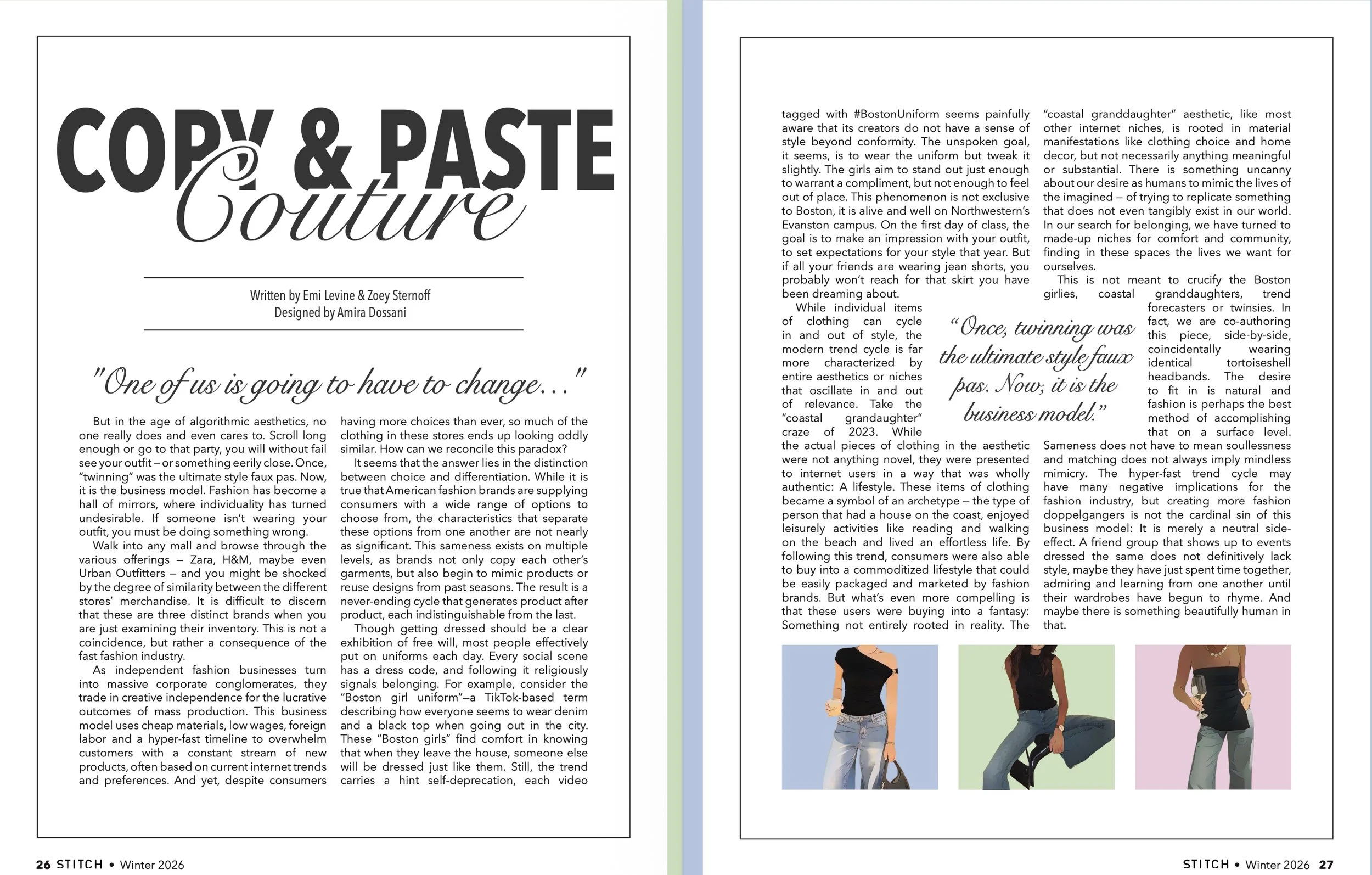
Though getting dressed should be a clear exhibition of free will, most people effectively put on uniforms each day. Every social scene has a dress code, and following it religiously signals belonging. For example, consider the “Boston girl uniform”—a TikTok-based term describing how everyone seems to wear denim and a black top when going out in the city. These “Boston girls” find comfort in knowing that when they leave the house, someone else will be dressed just like them. Still, the trend carries a hint self-deprecation, each video tagged with #BostonUniform seems painfully aware that its creators do not have a sense of style beyond conformity. The unspoken goal, it seems, is to wear the uniform but tweak it slightly. The girls aim to stand out just enough to warrant a compliment, but not enough to feel out of place. This phenomenon is not exclusive to Boston, it is alive and well on Northwestern’s Evanston campus. On the first day of class, the goal is to make an impression with your outfit, to set expectations for your style that year. But if all your friends are wearing jean shorts, you probably won’t reach for that skirt you have been dreaming about.
While individual items of clothing can cycle in and out of style, the modern trend cycle is far more characterized by entire aesthetics or niches that oscillate in and out of relevance. Take the “coastal grandaughter” craze of 2023. While the actual pieces of clothing in the aesthetic were not anything novel, they were presented to internet users in a way that was wholly authentic: A lifestyle. These items of clothing became a symbol of an archetype — the type of person that had a house on the coast, enjoyed leisurely activities like reading and walking on the beach and lived an effortless life. By following this trend, consumers were also able to buy into a commoditized lifestyle that could be easily packaged and marketed by fashion brands. But what’s even more compelling is that these users were buying into a fantasy: Something not entirely rooted in reality. The “coastal granddaughter” aesthetic, like most other internet niches, is rooted in material manifestations like clothing choice and home decor, but not necessarily anything meaningful or substantial. There is something uncanny about our desire as humans to mimic the lives of the imagined — of trying to replicate something that does not even tangibly exist in our world. In our search for belonging, we have turned to made-up niches for comfort and community, finding in these spaces the lives we want for ourselves.
This is not meant to crucify the Boston girlies, coastal granddaughters, trend forecasters or twinsies. In fact, we are co-authoring this piece, side-by-side, coincidentally wearing identical tortoiseshell headbands. The desire to fit in is natural and fashion is perhaps the best method of accomplishing that on a surface level. Sameness does not have to mean soullessness and matching does not always imply mindless mimicry. The hyper-fast trend cycle may have many negative implications for the fashion industry, but creating more fashion doppelgangers is not the cardinal sin of this business model: It is merely a neutral side-effect. A friend group that shows up to events dressed the same does not definitively lack style, maybe they have just spent time together, admiring and learning from one another until their wardrobes have begun to rhyme. And maybe there is something beautifully human in that.