
Looksmaxxing: When Beauty Becomes Data, What Makes Us Human?
Design by Insia Zaidi
“Cows all look the same, sheep all look the same, humans should all look the same.” - John Mew
Canthal tilt. Predator eyes. Prominent maxillas.
The looksmaxxing trend is essentially what it sounds like — maximizing one’s looks. Its participants aim to become the best looking and most attractive version of themselves by a set standard, including criteria like positive canthal tilts, “hunter eyes” (eyes angled upward towards the temples) and strong jawlines.
While looksmaxxing as a trend has seemingly only taken off in the past few years, its roots stretch back to the 1970s with John Mew, an orthodontist who believed that “most people (were) severely deformed” and that human faces have failed to develop properly.
In the documentary “Open Wide” about his controversial work, Mew shows off a device, similar to a retainer, that he created for children’s faces to develop properly. However, in mixed testimonies from his former patients, it’s revealed that the device makes it so that it’s painful for users to relax their jaws, effectively forcing the development of a strong jawline, a feature Mew deemed necessary to fix human “deformities.”
He also describes how he conducted these experiments on his own children, two of which he depicts as failures. His “successful” son, Mike, followed his father’s path and promoted the use of orthodontics to change people’s facial structures to fit his standard of beauty. However, it wasn’t until 2014, according to internet creator Nikki Carreon’s video essay “The Toxic World of Looksmaxxing,” that his practices went viral on young male alt-right media spheres and incel forums. The most popular, clenching one’s jaw to train its definition, became known as “mewing.”
The problem with looksmaxxing today isn’t mewing, excessive skincare or trying to debloat and clear up your skin — it’s the uncanny sense of uniformity, one-size-fits-all standard the community is veering towards.
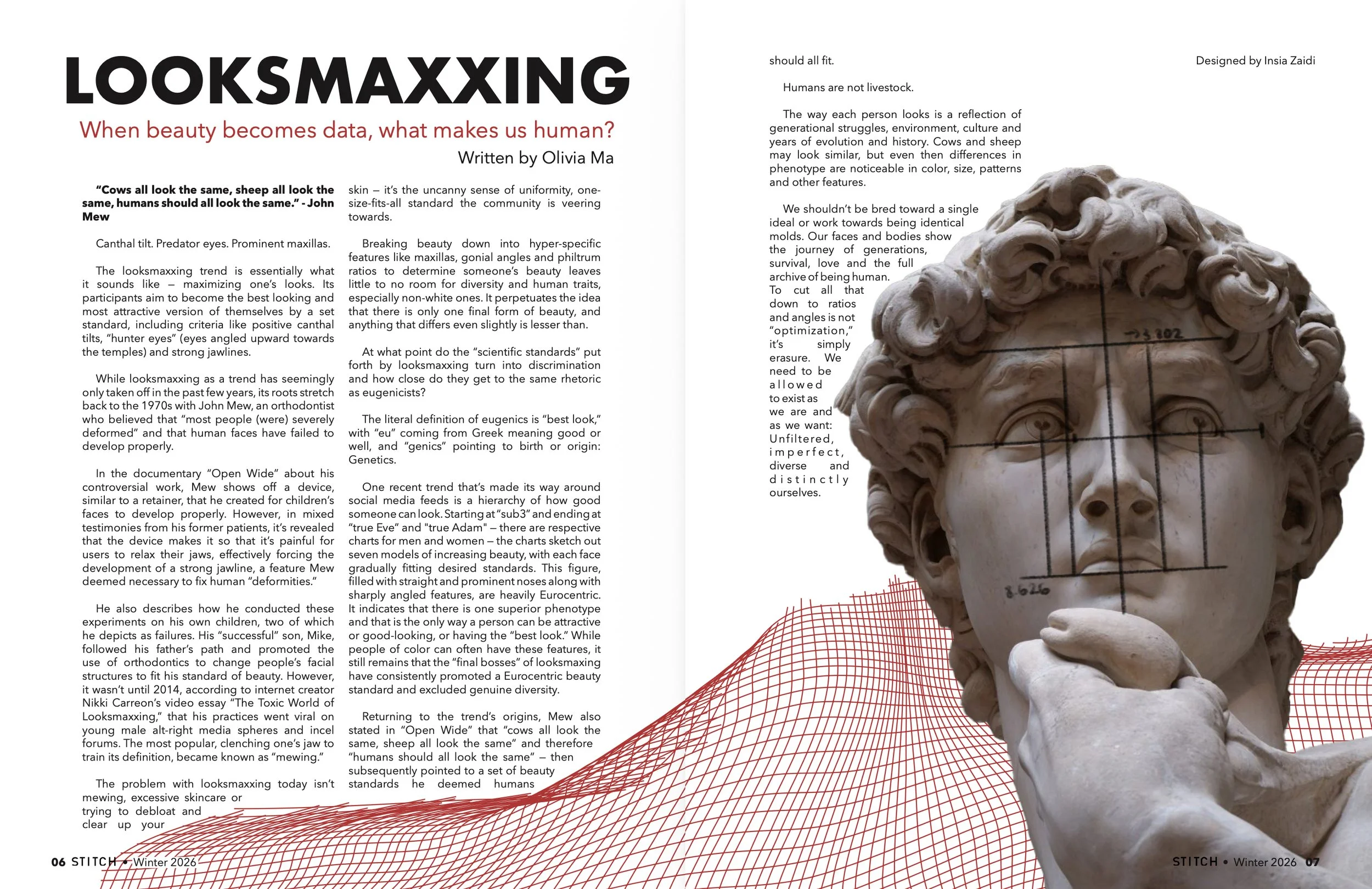
Breaking beauty down into hyper-specific features like maxillas, gonial angles and philtrum ratios to determine someone’s beauty leaves little to no room for diversity and human traits, especially non-white ones. It perpetuates the idea that there is only one final form of beauty, and anything that differs even slightly is lesser than.
At what point do the “scientific standards” put forth by looksmaxxing turn into discrimination and how close do they get to the same rhetoric as eugenicists?
The literal definition of eugenics is “best look,” with “eu” coming from Greek meaning good or well, and “genics” pointing to birth or origin: Genetics.
One recent trend that’s made its way around social media feeds is a hierarchy of how good someone can look. Starting at “sub3” and ending at “true Eve” and "true Adam" — there are respective charts for men and women — the charts sketch out seven models of increasing beauty, with each face gradually fitting desired standards. This figure, filled with straight and prominent noses along with sharply angled features, are heavily Eurocentric. It indicates that there is one superior phenotype and that is the only way a person can be attractive or good-looking, or having the “best look.” While people of color can often have these features, it still remains that the “final bosses” of looksmaxing have consistently promoted a Eurocentric beauty standard and excluded genuine diversity.
Returning to the trend’s origins, Mew also stated in “Open Wide” that “cows all look the same, sheep all look the same” and therefore “humans should all look the same” — then subsequently pointed to a set of beauty standards he deemed humans should all fit.
Humans are not livestock.
The way each person looks is a reflection of generational struggles, environment, culture and years of evolution and history. Cows and sheep may look similar, but even then differences in phenotype are noticeable in color, size, patterns and other features.
We shouldn’t be bred toward a single ideal or work towards being identical molds. Our faces and bodies show the journey of generations, survival, love and the full archive of being human. To cut all that down to ratios and angles is not “optimization,” it’s simply erasure. We need to be allowed to exist as we are and as we want: Unfiltered, imperfect, diverse and distinctly ourselves.