
FYP Mirror: The Uncanny Intimacy of Our Algorithm
Design by Kate Moores
What happens when technology starts mimicking the rhythms of intimacy?
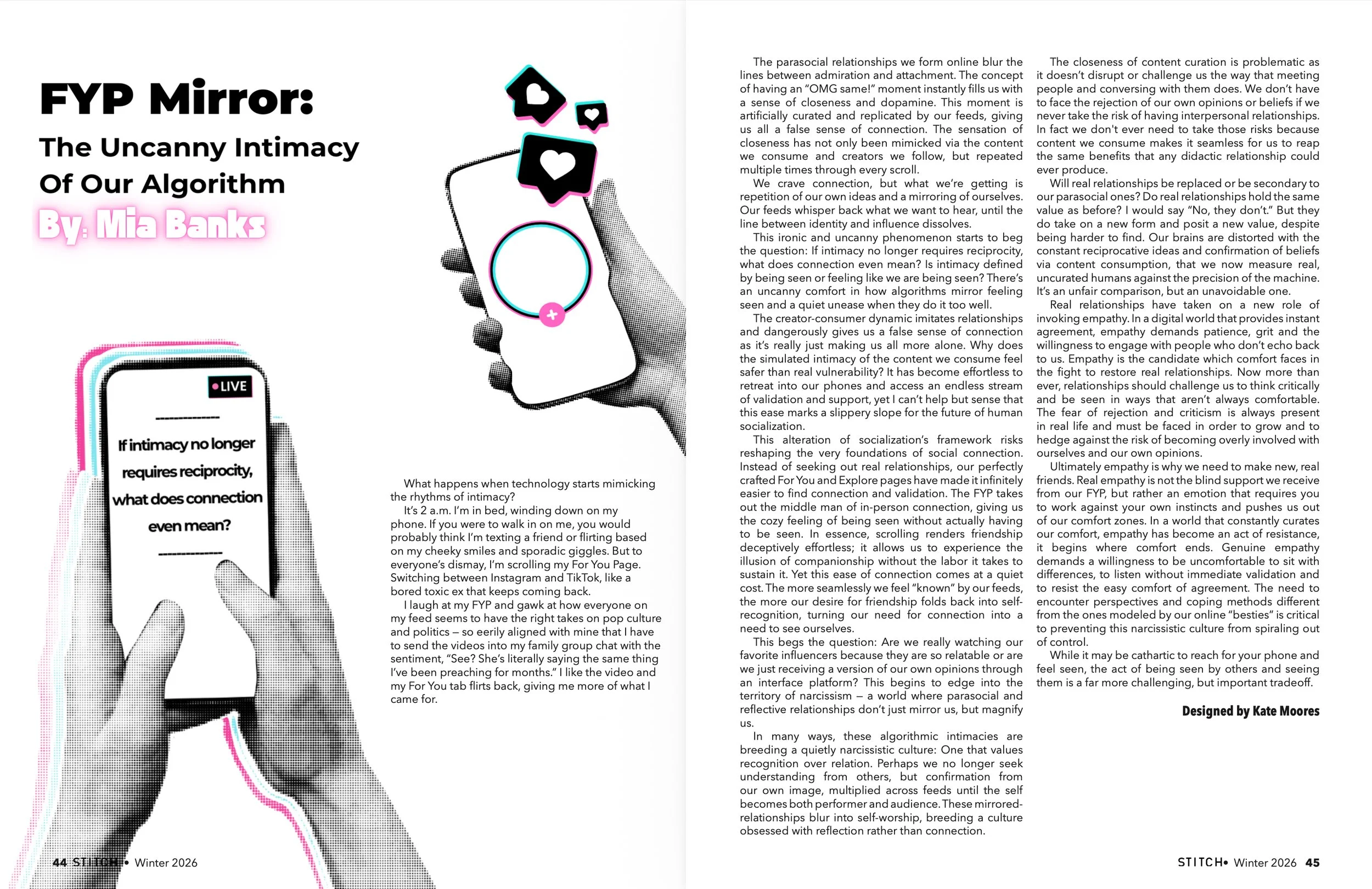
It’s 2 a.m. I’m in bed, winding down on my phone. If you were to walk in on me, you would probably think I’m texting a friend or flirting based on my cheeky smiles and sporadic giggles. But to everyone’s dismay, I’m scrolling my For You Page. Switching between Instagram and TikTok, like a bored toxic ex that keeps coming back.
I laugh at my FYP and gawk at how everyone on my feed seems to have the right takes on pop culture and politics — so eerily aligned with mine that I have to send the videos into my family group chat with the sentiment, “See? She’s literally saying the same thing I’ve been preaching for months.” I like the video and my For You tab flirts back, giving me more of what I came for.
The parasocial relationships we form online blur the lines between admiration and attachment. The concept of having an “OMG same!” moment instantly fills us with a sense of closeness and dopamine. This moment is artificially curated and replicated by our feeds, giving us all a false sense of connection. The sensation of closeness has not only been mimicked via the content we consume and creators we follow, but repeated multiple times through every scroll.
We crave connection, but what we’re getting is repetition of our own ideas and a mirroring of ourselves. Our feeds whisper back what we want to hear, until the line between identity and influence dissolves.
This ironic and uncanny phenomenon starts to beg the question: If intimacy no longer requires reciprocity, what does connection even mean? Is intimacy defined by being seen or feeling like we are being seen? There’s an uncanny comfort in how algorithms mirror feeling seen and a quiet unease when they do it too well.
The creator-consumer dynamic imitates relationships and dangerously gives us a false sense of connection as it’s really just making us all more alone. Why does the simulated intimacy of the content we consume feel safer than real vulnerability? It has become effortless to retreat into our phones and access an endless stream of validation and support, yet I can’t help but sense that this ease marks a slippery slope for the future of human socialization.
This alteration of socialization’s framework risks reshaping the very foundations of social connection. Instead of seeking out real relationships, our perfectly crafted For You and Explore pages have made it infinitely easier to find connection and validation. The FYP takes out the middle man of in-person connection, giving us the cozy feeling of being seen without actually having to be seen. In essence, scrolling renders friendship deceptively effortless; it allows us to experience the illusion of companionship without the labor it takes to sustain it. Yet this ease of connection comes at a quiet cost. The more seamlessly we feel “known” by our feeds, the more our desire for friendship folds back into self-recognition, turning our need for connection into a need to see ourselves.
This begs the question: Are we really watching our favorite influencers because they are so relatable or are we just receiving a version of our own opinions through an interface platform? This begins to edge into the territory of narcissism — a world where parasocial and reflective relationships don’t just mirror us, but magnify us.
In many ways, these algorithmic intimacies are breeding a quietly narcissistic culture: One that values recognition over relation. Perhaps we no longer seek understanding from others, but confirmation from our own image, multiplied across feeds until the self becomes both performer and audience. These mirrored-relationships blur into self-worship, breeding a culture obsessed with reflection rather than connection.
The closeness of content curation is problematic as it doesn’t disrupt or challenge us the way that meeting people and conversing with them does. We don’t have to face the rejection of our own opinions or beliefs if we never take the risk of having interpersonal relationships. In fact we don't ever need to take those risks because content we consume makes it seamless for us to reap the same benefits that any didactic relationship could ever produce.
Will real relationships be replaced or be secondary to our parasocial ones? Do real relationships hold the same value as before? I would say “No, they don’t.” But they do take on a new form and posit a new value, despite being harder to find. Our brains are distorted with the constant reciprocative ideas and confirmation of beliefs via content consumption, that we now measure real, uncurated humans against the precision of the machine. It’s an unfair comparison, but an unavoidable one.
Real relationships have taken on a new role of invoking empathy. In a digital world that provides instant agreement, empathy demands patience, grit and the willingness to engage with people who don’t echo back to us. Empathy is the candidate which comfort faces in the fight to restore real relationships. Now more than ever, relationships should challenge us to think critically and be seen in ways that aren’t always comfortable. The fear of rejection and criticism is always present in real life and must be faced in order to grow and to hedge against the risk of becoming overly involved with ourselves and our own opinions.
Ultimately empathy is why we need to make new, real friends. Real empathy is not the blind support we receive from our FYP, but rather an emotion that requires you to work against your own instincts and pushes us out of our comfort zones. In a world that constantly curates our comfort, empathy has become an act of resistance, it begins where comfort ends. Genuine empathy demands a willingness to be uncomfortable to sit with differences, to listen without immediate validation and to resist the easy comfort of agreement. The need to encounter perspectives and coping methods different from the ones modeled by our online “besties” is critical to preventing this narcissistic culture from spiraling out of control.
While it may be cathartic to reach for your phone and feel seen, the act of being seen by others and seeing them is a far more challenging, but important tradeoff.