
Between Angel and Android: The Haunting Aesthetic of Pop Women
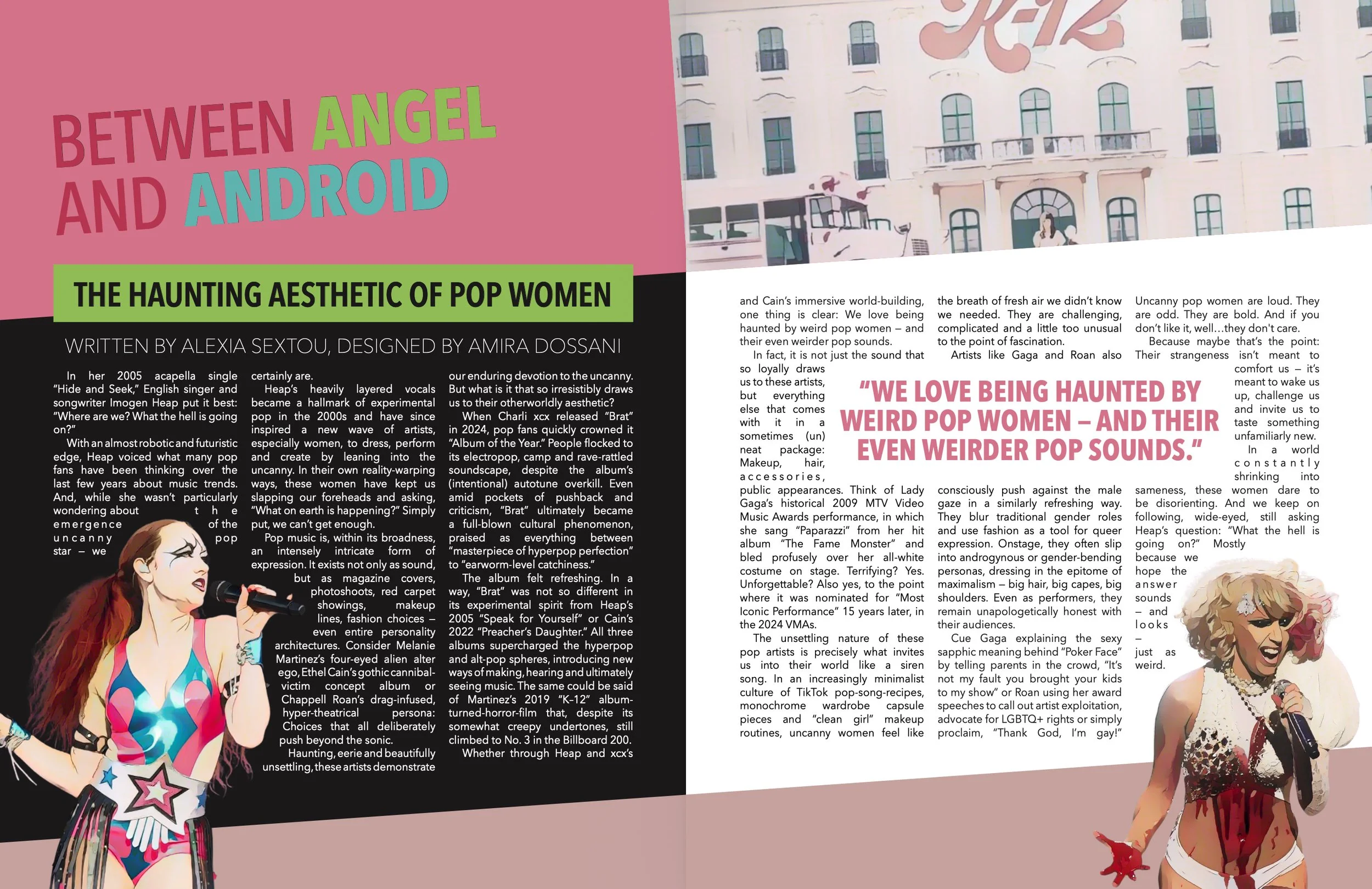
Design by Amira Dossani
In her 2005 acapella single “Hide and Seek,” English singer and songwriter Imogen Heap put it best: “Where are we? What the hell is going on?”
With an almost robotic and futuristic edge, Heap voiced what many pop fans have been thinking over the last few years about music trends. And, while she wasn’t particularly wondering about the emergence of the uncanny pop star — we certainly are.
Heap’s heavily layered vocals became a hallmark of experimental pop in the 2000s and have since inspired a new wave of artists, especially women, to dress, perform and create by leaning into the uncanny. In their own reality-warping ways, these women have kept us slapping our foreheads and asking, “What on earth is happening?” Simply put, we can’t get enough.
Pop music is, within its broadness, an intensely intricate form of expression. It exists not only as sound, but as magazine covers, photoshoots, red carpet showings, makeup lines, fashion choices — even entire personality architectures. Consider Melanie Martinez’s four-eyed alien alter ego, Ethel Cain’s gothic cannibal-victim concept album or Chappell Roan’s drag-infused, hyper-theatrical persona: Choices that all deliberately push beyond the sonic.
Haunting, eerie and beautifully unsettling, these artists demonstrate our enduring devotion to the uncanny. But what is it that so irresistibly draws us to their otherworldly aesthetic?
When Charli xcx released “Brat” in 2024, pop fans quickly crowned it “Album of the Year.” People flocked to its electropop, camp and rave-rattled soundscape, despite the album’s (intentional) autotune overkill. Even amid pockets of pushback and criticism, “Brat” ultimately became a full-blown cultural phenomenon, praised as everything between “masterpiece of hyperpop perfection” to “earworm-level catchiness.”
The album felt refreshing. In a way, “Brat” was not so different in its experimental spirit from Heap’s 2005 “Speak for Yourself” or Cain’s 2022 “Preacher’s Daughter.” All three albums supercharged the hyperpop and alt-pop spheres, introducing new ways of making, hearing and ultimately seeing music. The same could be said of Martinez’s 2019 “K–12” album-turned-horror-film that, despite its somewhat creepy undertones, still climbed to No. 3 in the Billboard 200.
Whether through Heap and xcx’s vocal-tech manipulation or Martinez and Cain’s immersive world-building, one thing is clear: We love being haunted by weird pop women — and their even weirder pop sounds.
In fact, it is not just the sound that so loyally draws us to these artists, but everything else that comes with it in a sometimes (un)neat package: Makeup, hair, accessories, public appearances. Think of Lady Gaga’s historical 2009 MTV Video Music Awards performance, in which she sang “Paparazzi” from her hit album “The Fame Monster” and bled profusely over her all-white costume on stage. Terrifying? Yes. Unforgettable? Also yes, to the point where it was nominated for “Most Iconic Performance” 15 years later, in the 2024 VMAs.
The unsettling nature of these pop artists is precisely what invites us into their world like a siren song. In an increasingly minimalist culture of TikTok pop-song-recipes, monochrome wardrobe capsule pieces and “clean girl” makeup routines, uncanny women feel like the breath of fresh air we didn’t know we needed. They are challenging, complicated and a little too unusual to the point of fascination.
Artists like Gaga and Roan also consciously push against the male gaze in a similarly refreshing way. They blur traditional gender roles and use fashion as a tool for queer expression. Onstage, they often slip into androgynous or gender-bending personas, dressing in the epitome of maximalism — big hair, big capes, big shoulders. Even as performers, they remain unapologetically honest with their audiences.
Cue Gaga explaining the sexy sapphic meaning behind “Poker Face” by telling parents in the crowd, “It’s not my fault you brought your kids to my show” or Roan using her award speeches to call out artist exploitation, advocate for LGBTQ+ rights or simply proclaim, “Thank God, I’m gay!” Uncanny pop women are loud. They are odd. They are bold. And if you don’t like it, well…they don't care.
Because maybe that’s the point: Their strangeness isn’t meant to comfort us — it’s meant to wake us up, challenge us and invite us to taste something unfamiliarly new.
In a world constantly shrinking into sameness, these women dare to be disorienting. And we keep on following, wide-eyed, still asking Heap’s question: “What the hell is going on?” Mostly because we hope the answer sounds — and looks — just as weird.