
Why On This Galaxy Do We Want To #BringBack2016?
Graphic by Alexia Sextou
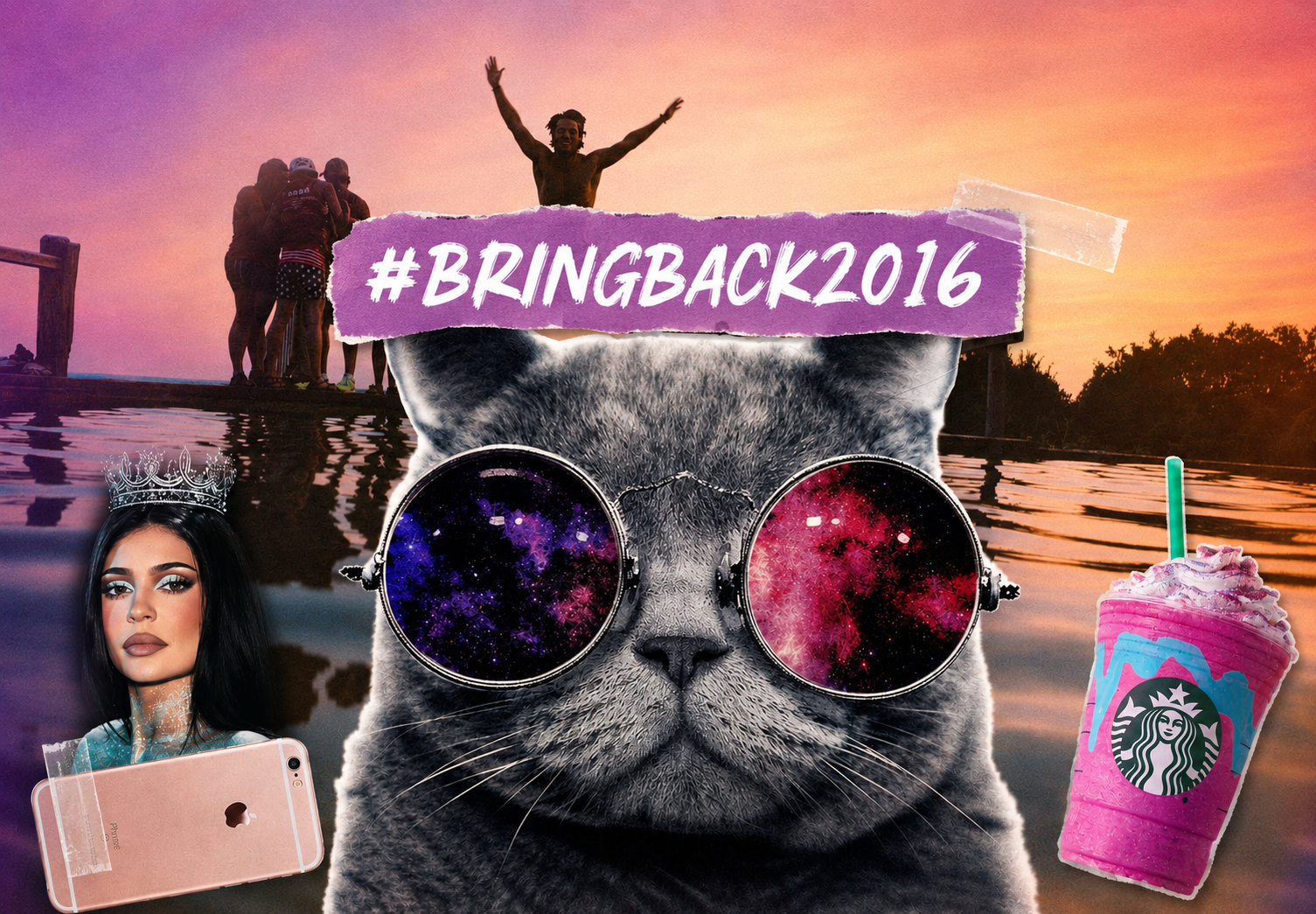
Palm-tree gradients. Galaxy prints. Tumblr quotes floating over pastel sunsets. Justin Bieber’s praying silhouette edited in front of a Los Angeles beachfront. Yes, this year, 2016 is “so back.”
Somewhere between ironic TikTok edits and Pinterest moodboards labeled “#BringBack2016,” you’ll find that millennial optimism has boldly segwayed back into our lives.
We all remember it: that mindless, pervasive, hopeful mindset among millennials during the 2010s hailing social progress, career potential — and, of course — “#stayingtruetoyourself.”
Yet the real question isn’t whether 2016 is trending again. It’s why we suddenly want it back.
For a brief cultural moment, the mid-2010s also sold us a fantasy of endless becoming. Or rather, “re-becoming.” We collectively adopted a sense of reinvention packaged as rebirth; romanticization of Indigenous dreamcatchers as room decor, appropriation of Hindu meditation practices as self-healing, intentionally messy buns as the illusion of carefree imperfection.
We just loved slapping on a mustache finger tattoo and calling ourselves “free.”
Brands followed along with our re-emerging nostalgia, too. In October, Kylie Cosmetics’ anniversary drop resurrected “King Kylie” makeup products — paying homage to Kylie Jenner’s teal-ombré hair, cut-crease lids and sideways beanie era. A time when even a Kardashian could quirkily experiment with her looks and be praised as influential.
Now, ten years later, we yearn for a stylistic overkill and simultaneous carefree quirkiness — the very aesthetic we mocked not too long ago during our 2020 “alternative era.” It makes you wonder why on earth we’re begging for 2016 back, knowing full well we have outgrown it.
Is our nostalgia for the previous decade a gleam of hope or a desperate cry for help?
Part of the appeal seems to be simple emotional math. The present moment feels heavy — economically, politically, culturally — and nostalgia tends to flatten complexity into warmth.
Looking back at 2016 through today’s lens transforms it into a “simpler time.” It’s almost as if we’re suddenly viewing life through Instagram’s Rio de Janeiro filter. Psychologists famously call it “hindsight bias,” our tendency to remember the past as more coherent or optimistic than it felt while we were living it.
In a way, the galaxy-print era becomes shorthand for a now-extinct time. We miss the year of pre-burnout internet and pre-doom-scrolling. In fact, 2016 arguably was the last year in which we experienced the final positive residues of influencer culture — a world with inspirational quotes, quirky DIY YouTube videos and beat-heavy party songs about how young we are.
But nostalgia alone doesn’t explain why millennial optimism is reappearing specifically on runways and feeds. The deeper reason might be technological.
Around 2016, social media entered its first fully aestheticized boom. Snapchat filters blurred imperfections into soft halos, Instagram grids curated entire identities and early influencers built aspirational worlds that felt personal rather than corporate.
Fashion mirrored this energy, too, with saturated colors, celestial motifs and silhouettes that prioritized self-expression over cynicism. It was the internet’s “coming-of-age” phase before algorithms sharpened into something harsher and personal branding began to feel compulsory.
Today’s revival of optimism looks different. Our optimism is also no longer community-based. Instead, it’s all about the “self-” prefix in our language: we look at self-help books, practice self-healing and glamorize self-care. We have repackaged ourselves into a limiting, individualistic hope for the future, through a forced need for minimalism that feels short-lived and dispensable.
It's precisely why we want 2016 to be “#soback.” It seems, after all, as though we are not nostalgic for millennial optimism itself, but for a more authentic version of ourselves that still believed in it.
Maybe, then, 2016 wasn’t the golden age we imagine. It was simply the last moment when the internet felt new enough to promise connection rather than exhaustion. Still, the fact that its aesthetic is resurfacing indicates we’re searching for a softer visual language to counter a harder world.
Maybe the gift of hindsight is our ability to choose the elements we hope to revive in 2026. While ripped jeans and galaxy prints may not walk the runway again, this time they carry a symbolic weight.
It isn’t about bringing back the year 2016 now, nor bringing back 2026 in ten years. It’s about reviving our carefree boldness — the instinct to be glittery, dramatic and stylistically loud in a “sad beige baby” world full of muted palettes, pilates routines and oat-milk minimalism.
After all, nostalgia isn’t about going back; it’s about stitching together a version of hope that still fits. And for this, 2016 is perhaps the most timeless era to refer back to.