
How Jennie's "ZEN" Is A Great Example Of Rhythm
Designed by Linda Montejo-Bartolon
Fashion has become inseparable from performance in today’s fastevolving music industry. From the United States to South Korea, fashion supports performer's ability to share a story with their sound. The music video for “ZEN,” a track off of BLACKPINK member Jennie’s new album Ruby, offers a visually rich experience: each outfit aligns with the song’s rhythm and emotional tone. Directed by photographer Cho Gi-Seok and styled by Park Min Hee, fashion is used as a visual metronome, tracking the song’s tempo and progressing moods, from airy to aggressive emotions, creating a cohesive narrative. The creative team places every hemline, accessory and silhouette with precision to form a secondary rhythm dancing alongside the music.
In the K-Pop world, stylists collaborate closely with producers, choreographers and directors to build costumes that fit the song’s emotional pace and rhythm. From soft, flowing fabrics moving gently with slower beats to sharp silhouettes echoing the intensity of choruses, fashion visually expresses the rhythm of a song. The video exemplifies this idea through dozens of different outfits to visually narrate the progression of “ZEN.” Each look indicates to the audience the emotions they are supposed to feel with the music.
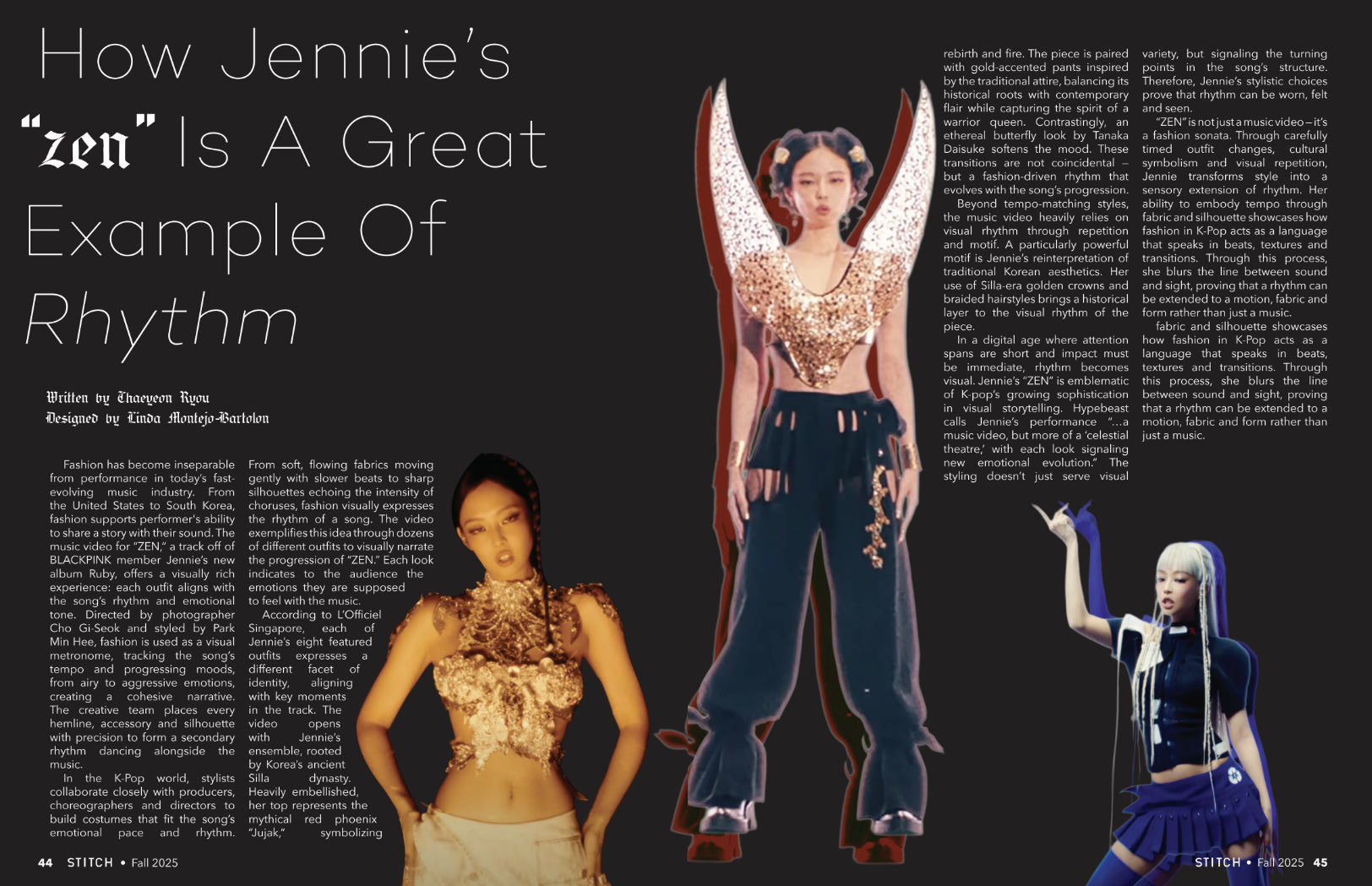
According to L’Officiel Singapore, each of Jennie’s eight featured outfits expresses a different facet of identity, aligning with key moments in the track. The video opens with Jennie’s ensemble, rooted by Korea’s ancient Silla dynasty. Heavily embellished, her top represents the mythical red phoenix “Jujak,” symbolizing rebirth and fire. The piece is paired with gold-accented pants inspired by the traditional attire, balancing its historical roots with contemporary flair while capturing the spirit of a warrior queen. Contrastingly, an ethereal butterfly look by Tanaka Daisuke softens the mood. These transitions are not coincidental — but a fashion-driven rhythm that evolves with the song’s progression.
Beyond tempo-matching styles, the music video heavily relies on visual rhythm through repetition and motif. A particularly powerful motif is Jennie’s reinterpretation of traditional Korean aesthetics. Her use of Silla-era golden crowns and braided hairstyles brings a historical layer to the visual rhythm of the piece.
In a digital age where attention spans are short and impact must be immediate, rhythm becomes visual. Jennie’s “ZEN” is emblematic of K-pop’s growing sophistication in visual storytelling. Hypebeast calls Jennie’s performance “…a music video, but more of a ‘celestial theatre,’ with each look signaling new emotional evolution.” The styling doesn’t just serve visual variety, but signaling the turning points in the song’s structure. Therefore, Jennie’s stylistic choices prove that rhythm can be worn, felt and seen.
“ZEN” is not just a music video — it’s a fashion sonata. Through carefully timed outfit changes, cultural symbolism and visual repetition, Jennie transforms style into a sensory extension of rhythm. Her ability to embody tempo through fabric and silhouette showcases how fashion in K-Pop acts as a language that speaks in beats, textures and transitions. Through this process, she blurs the line between sound and sight, proving that a rhythm can be extended to a motion, fabric and form rather than just a music.
Fabric and silhouette showcases how fashion in K-Pop acts as a language that speaks in beats, textures and transitions. Through this process, she blurs the line between sound and sight, proving that a rhythm can be extended to a motion, fabric and form rather than just a music.