
From Hide to Haute: The Talking Drum's Influence on Rhythm and Fashion
Designed by Rachel Smith
Does the drum speak? Can you understand its words?
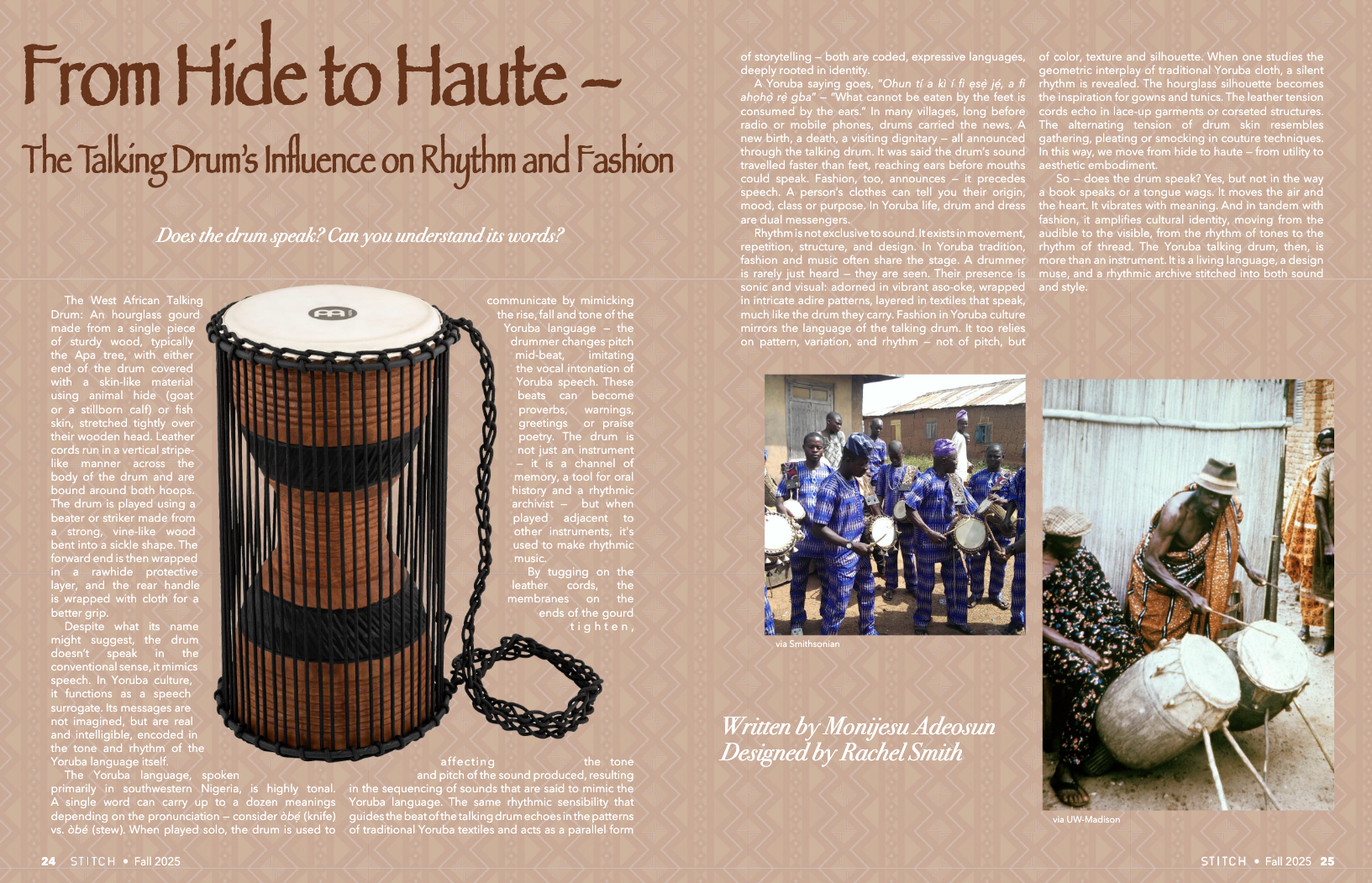
The West African Talking Drum. An hourglass gourd made from a single piece of sturdy wood, typically the Apa tree, with either end of the drum covered with a skin-like material using animal hide (goat or a stillborn calf) or fish skin, stretched tightly over their wooden head. Leather cords run in a vertical stripe-like manner across the body of the drum and are bound around both hoops. The drum is played using a beater or striker made from a strong, vine-like wood bent into a sickle shape. The forward end is then wrapped in a rawhide protective layer, and the rear handle is wrapped with cloth for a better grip.
Despite what its name might suggest, the drum doesn’t speak in the conventional sense, it mimics speech. In Yoruba culture, it functions as a speech surrogate. Its messages are not imagined, but are real and intelligible, encoded in the tone and rhythm of the Yoruba language itself.
The Yoruba language, spoken primarily in southwestern Nigeria, is highly tonal. A single word can carry up to a dozen meanings depending on the pronunciation — consider òbẹ́ (knife) vs. òbé (stew). When played solo, the drum is used to communicate by mimicking the rise, fall, and tone of the Yoruba language– the drummer changes pitch mid-beat, imitating the vocal intonation of Yoruba speech. These beats can become proverbs, warnings, greetings, or praise poetry. The drum is not just an instrument — it is a channel of memory, a tool for oral history, and a rhythmic archivist– but when played adjacent to other instruments, it's used to make rhythmic music.
By tugging on the leather cords, the membranes on the ends of the gourd tighten, affecting the tone and pitch of the sound produced, resulting in the sequencing of sounds that are said to mimic the Yoruba language. The same rhythmic sensibility that guides the beat of the talking drum echoes in the patterns of traditional Yoruba textiles and acts as a parallel form of storytelling — both are coded, expressive languages, deeply rooted in identity.
A Yoruba saying goes, “Ohun tí a kì í fi ẹsẹ̀ jẹ́, a fi ahọhọ̀ rẹ̀ gba” — “What cannot be eaten by the feet is consumed by the ears.” In many villages, long before radio or mobile phones, drums carried the news. A new birth, a death, a visiting dignitary — all announced through the talking drum. It was said the drum’s sound travelled faster than feet, reaching ears before mouths could speak. Fashion, too, announces — it precedes speech. A person’s clothes can tell you their origin, mood, class, or purpose. In Yoruba life, drum and dress are dual messengers.
Rhythm is not exclusive to sound. It exists in movement, repetition, structure, and design. In Yoruba tradition, fashion and music often share the stage. A drummer is rarely just heard — they are seen. Their presence is sonic and visual: adorned in vibrant aso-oke, wrapped in intricate adire patterns, layered in textiles that speak, much like the drum they carry. Fashion in Yoruba culture mirrors the language of the talking drum. It too relies on pattern, variation, and rhythm — not of pitch, but of color, texture, and silhouette. When one studies the geometric interplay of traditional Yoruba cloth, a silent rhythm is revealed. The hourglass silhouette becomes the inspiration for gowns and tunics. The leather tension cords echo in lace-up garments or corseted structures. The alternating tension of drum skin resembles gathering, pleating, or smocking in couture techniques. In this way, we move from hide to haute — from utility to aesthetic embodiment.
So — does the drum speak? Yes, but not in the way a book speaks or a tongue wags. It moves the air and the heart. It vibrates with meaning. And in tandem with fashion, it amplifies cultural identity, moving from the audible to the visible, from the rhythm of tones to the rhythm of thread. The Yoruba talking drum, then, is more than an instrument. It is a living language, a design muse, and a rhythmic archive stitched into both sound and style.