
Am I Crossing the Line?
Every shade of every color, made from countless kinds of beads. Beside me, I see rows of them — enough for endless prayer. I browse the selections as I would normally, thinking about which hues I would wear most or which one would most effortlessly integrate into an outfit from my Pinterest board.
My instinct to consider color, personal style, and how each piece might fit into my wardrobe comes to mind naturally. As I hold options up to myself, I see how they look with my skin tone. Maybe I looked like I practice, or maybe I blended in with every other tourist. I almost laughed thinking what Saint Peter might say about this moment, “A non-Catholic buying a rosary because he thinks it’s cute at a gift shop in the Vatican.”
My best friend approaches me.
“Are you actually gonna get one?,” she says.
I pause and reply, “I think so.”
“What for?” she asks.
Fair question. I feel embarrassed to say why I really want to buy the rosary to my best friend, a Christian who attends the religious Pepperdine University. This is the girl who, just days before our stop at this gift shop, gave me a tour of her school's villa in Florence. A building with custom stained glass windows and its very own private prayer room. I forget what I ended up telling her, but it was probably something about how my mom would like it if I got a rosary from the Vatican — “for protection.”
Nevertheless, I end up going through with the purchase with my eyes leading the way, and my brain and heart following loosely behind.
I felt unsatisfied with my response to my best friend when she asked me why I wanted the rosary, because I didn’t tell her the truth: I got it because I liked the rosary's aesthetic. She has never been one to judge me or make me feel weird for liking things she does not. Falling into an internal loophole, I thought deeply about why I desired to buy the rosary — a major symbol of Catholicism — when I have no institutional history with it.
Reflecting more, I found that despite not belonging to the Christian church, I still felt connected to its iconography. I am someone who gets emotionally intertwined with the music I listen to. In November 2025, Spanish popstar Rosalía released her album “LUX.” The album is a deeply spiritual exploration of various female saints and the globality of faith. I was consuming the album in every medium possible: through its moving religious imagery, lyrics like poetry and music videos that were more like cinematic productions.
My listening in itself became a sort of religious practice. Her contemplative use of Catholic imagery made the religion and its messages accessible to me. I felt connected to the religion through her music, each song a prayer immersing me into the culture.
As my time in Italy came to a close, I lost proximity to historically and culturally significant Catholic landmarks, such as Florence’s Duomo. With Rosalía’s “LUX” setting the backdrop of my trip to Italy, my travels and the soundtrack coincided with my first college heartbreak. So, heading home was emotionally charged to say the least. I had packed my new rosary in a small pocket of my personal item on the flight, to keep it close to me while in the air. For protection.
The airplane home took off, I had an entire row to myself and I pressed play on “Magnolias” from “LUX,” a poignant song expressing themes of death, transcendence and legacy. At that moment, I began to cry, reflecting on my experiences in Italy, the emotional context I existed in and my return home. I texted a friend who shared my affinity for Rosalía: “Cried to Magnolias on the plane today. I'm healed.”
“God. And tears shed in the air are weightless. You set them free and then come down to Earth refreshed and renewed,” she responded.
Finally home, I took a picture wearing my rosary as it lay on my shirt in harmony with the pleated folds and various blues. I really admired the picture, and felt inclined to share it on social media. It was a great representation of where I was at the moment, what was resonating with me and how I was showing up in life.
Yet again, I hesitated. I felt weird about sharing it publicly. I figured, just as my best friend did, that my intention of wearing a rosary might be questioned. So, I archived it on my main Instagram page. That way, the picture, my new rosary, was on my page if people looked, but I wasn’t making an announcement about it.
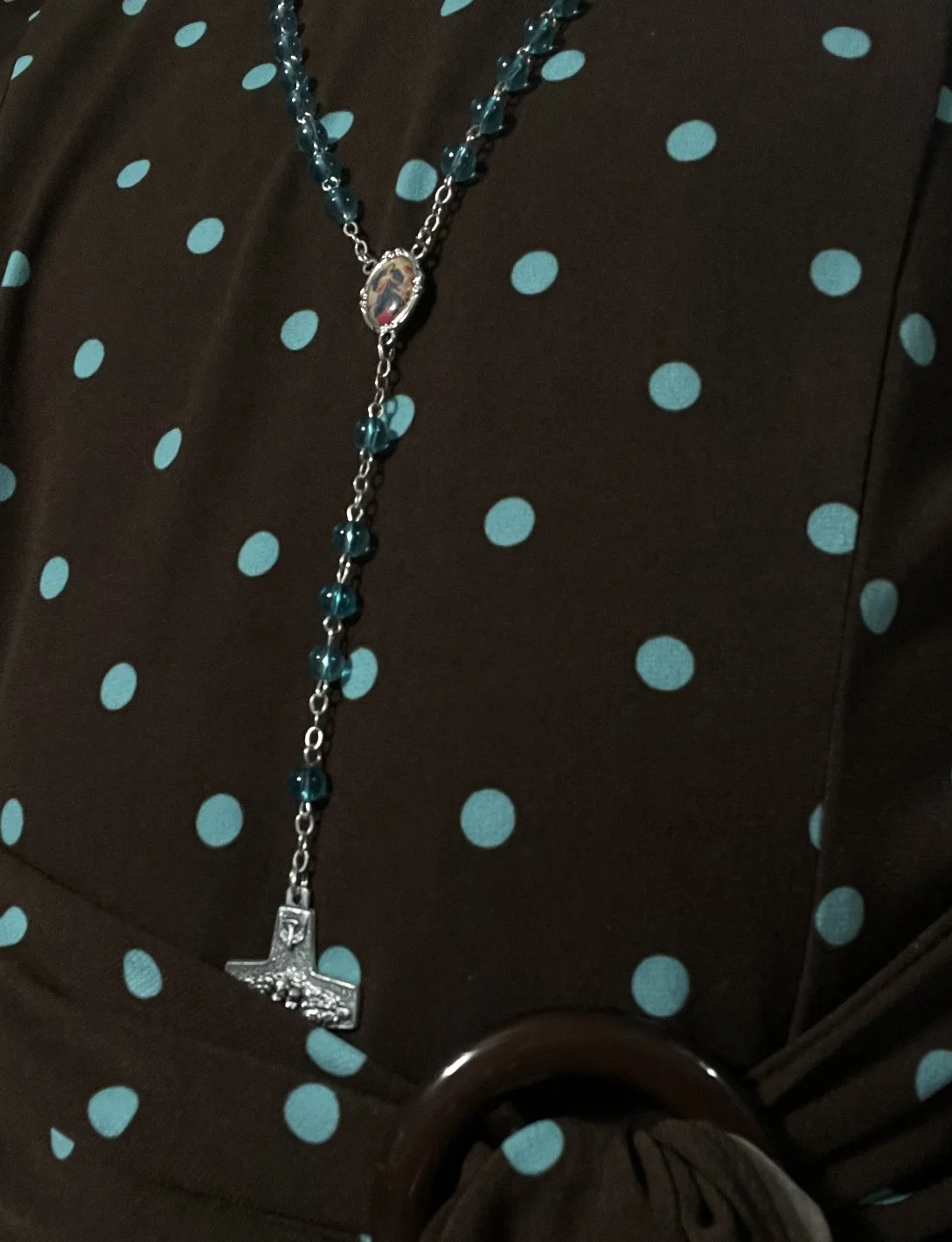
Originally posted January 24, 2026, and archived shortly after. Reinstated to the author's Instagram feed on February 14, 2026, where it remains publicly visible.
As I sat with my decision, I felt my heart and brain catch up to me. Rosalía is just one of many artists who use religion to expand and incorporate their artistry. Are those who align with these projects and act similarly to me crossing a line? Is religion too sacred to be the premise for non-worship music or fashion and for people to access it through these uninstitutionalized measures?
I will say that although I initially acted from a desire to visually align with Rosalia’s “LUX,” my heart tells me there is a deeper alignment with the messages of Catholicism packaged in the album. And if that is not religious — what is?