
The Beautiful Monster: When Fashion Makes Horror Seductive
Design by Yzabelle De Luna
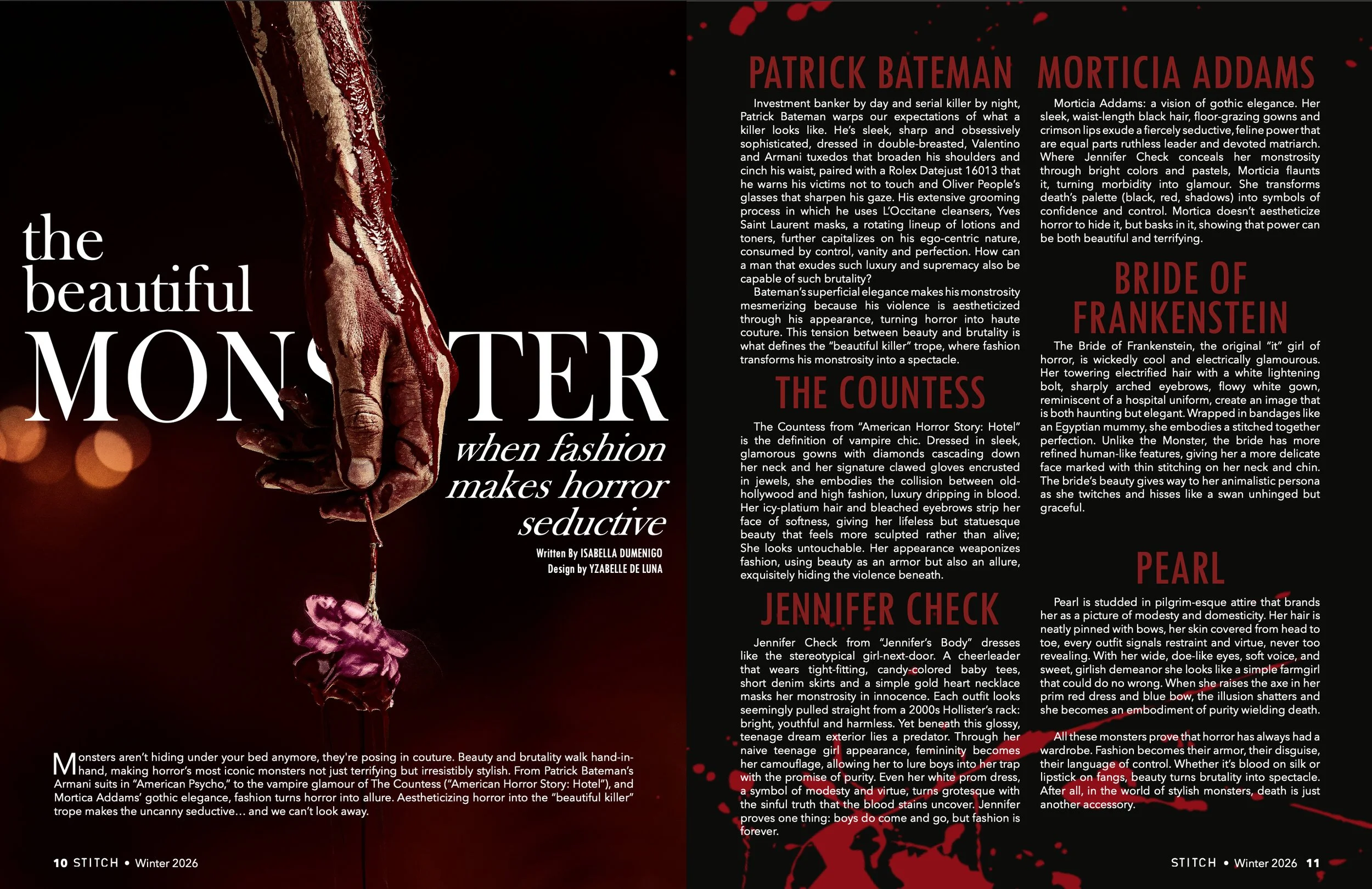
Monsters aren’t hiding under your bed anymore, they're posing in couture. Beauty and brutality walk hand-in-hand, making horror’s most iconic monsters not just terrifying but irresistibly stylish. From Patrick Bateman’s Armani suits in “American Psycho,” to the vampire glamour of The Countess (“American Horror Story: Hotel”), and Morticia Addams’ gothic elegance, fashion turns horror into allure. Aestheticizing horror into the “beautiful killer” makes the uncanny seductive… and we can’t look away.
Patrick Bateman
Investment banker by day and serial killer by night, Patrick Bateman warps our expectations of what a killer looks like. He’s sleek, sharp and obsessively sophisticated, dressed in double-breasted, Valentino and Armani tuxedos that broaden his shoulders and cinch his waist, paired with a Rolex Datejust 16013 that he warns his victims not to touch and Oliver People’s glasses that sharpen his gaze. His extensive grooming process in which he uses L’Occitane cleansers, Yves Saint Laurent masks, a rotating lineup of lotions and toners, further capitalizes on his ego-centric nature, consumed by control, vanity, and perfection. How can a man that exudes such luxury and supremacy also be capable of such brutality?
Bateman’s superficial elegance makes his monstrosity mesmerizing because his violence is aestheticized through his appearance, turning horror into haute couture. This tension between beauty and brutality is what defines the “beautiful killer” trope, where fashion transforms his monstrosity into a spectacle.
The Countess
The Countess from “American Horror Story: Hotel” is the definition of vampire chic. Dressed in sleek, glamorous gowns with diamonds cascading down her neck and her signature clawed gloves encrusted in jewels, she embodies the collision between old Hollywood and high fashion, luxury dripping in blood. Her icy-platinum hair and bleached eyebrows strip her face of softness, giving her lifeless but statuesque beauty that feels more sculpted rather than alive; She looks untouchable. Her appearance weaponizes fashion, using beauty as an armor but also an allure, exquisitely hiding the violence beneath.
Jennifer Check
Jennifer Check from “Jennifer’s Body” dresses like the stereotypical girl-next-door. A cheerleader that wears tight-fitting, candy-colored baby tees, short denim skirts, and a simple gold heart necklace masks her monstrosity in innocence. Each outfit looks seemingly pulled straight from a 2000s Hollister’s rack: bright, youthful and harmless. Yet beneath this glossy, teenage dream exterior lies a predator. Through her naive teenage girl appearance, femininity becomes her camouflage, allowing her to lure boys into her trap with the promise of purity. Even her white prom dress, a symbol of modesty and virtue, turns grotesque with the sinful truth that the bloodstains uncover. Jennifer proves one thing: boys do come and go, but fashion is forever.
Morticia Addams
Mortica Addams: a vision serves of elegance. Her sleek, waist-length black hair, floor-grazing gowns and crimson lips exude a fiercely seductive, feline power that are equal parts ruthless leader and devoted matriarch. Where Jennifer Check conceals her monstrosity through bright colors and pastels, Morticia flaunts it, turning morbidity into glamour. She transforms death’s palette (black, red, shadows) into symbols of confidence and control. Morticia doesn’t aestheticize horror to hide it, but basks in it, showing that power can be both beautiful and terrifying.
Bride of Frankenstein
The Bride of Frankenstein, the original “it” girl of horror, is wickedly cool and electrically glamourous. Her towering electrified hair with a white lightning bolt, sharply arched eyebrows, flowy white gown, reminiscent of a hospital uniform, create an image that is both haunting but elegant. Wrapped in bandages like an Egyptian mummy, she embodies a stitched together perfection. Unlike the Monster, the bride has more refined human-like features, giving her a more delicate face marked with thin stitching on her neck and chin. The bride's beauty gives way to her animalistic persona as she twitches and hisses like a swan unhinged but graceful.
Pearl
Pearl is studded in pilgrim-esque attire that brands her as a picture of modesty and domesticity. Her hair is neatly pinned with bows, her skin covered from head to toe, every outfit signals restraint and virtue, never too revealing. With her wide, doe-like eyes, soft voice and sweet, girlish demeanor she looks like a simple farmgirl that could do no wrong. When she raises the axe in her prim red dress and blue bow, the illusion shatters, and she becomes purity wielding death.
All these monsters prove that horror has always had a wardrobe. Fashion becomes their armor, their disguise, their language of control. Whether it’s blood on silk or lipstick on fangs, beauty turns brutality into spectacle. After all, in the world of stylish monsters, death is just another accessory.