
Inside New York's Auction Season
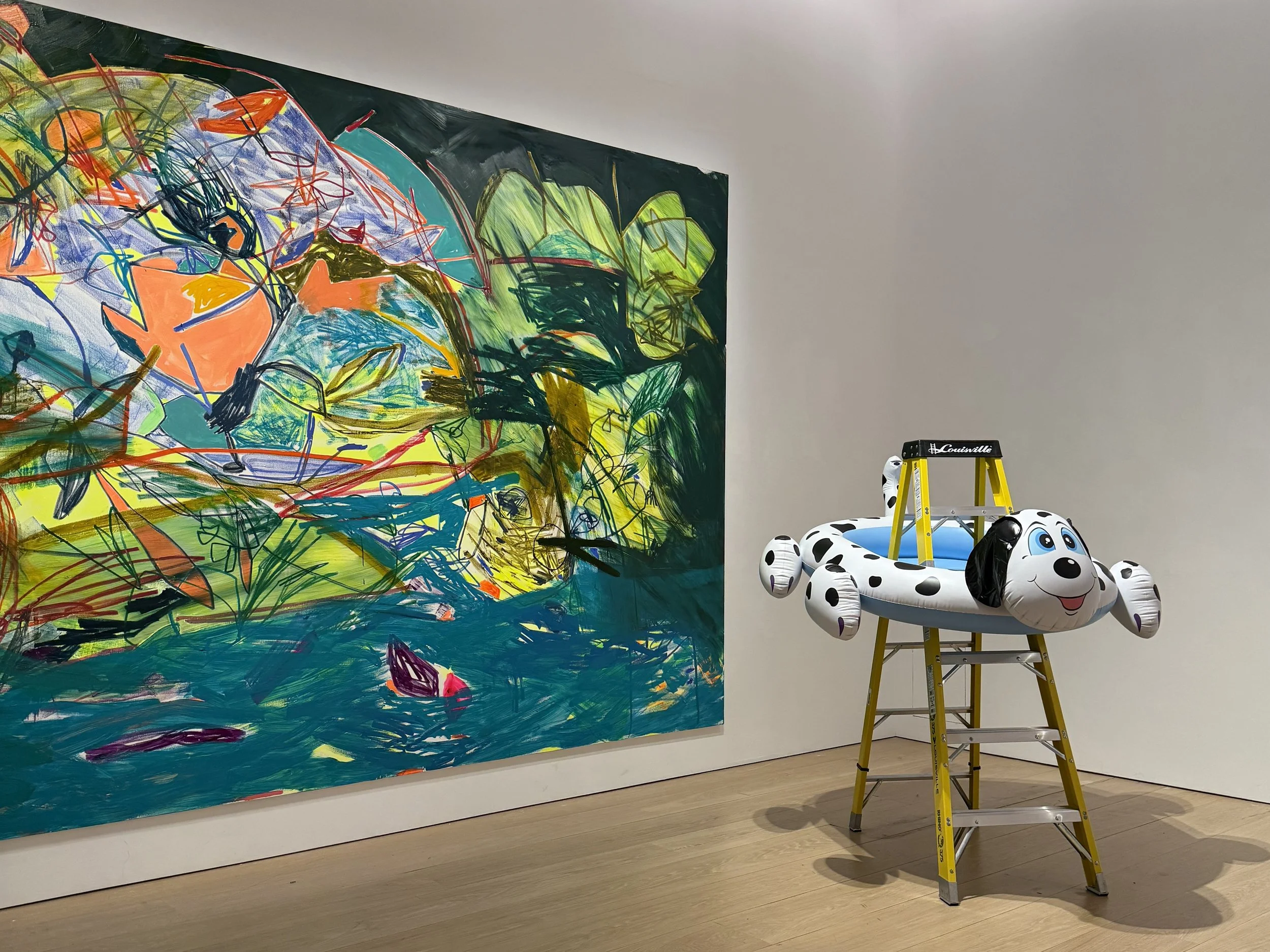
Piece by Jadé Fadojutimi next to a Jeff Koons sculpture / Photo by Mia Lin
Auction season in New York has a way of swallowing you whole. The city moves faster and shinier in these weeks, charged with a kind of anticipatory electricity. As someone who studied fine arts at Parsons before transferring to Northwestern, I was used to wandering small Lower East Side and Soho galleries, slipping into white rooms that felt more like studios than storefronts. But walking into Phillips for its pre-auction collection this fall, after months in Evanston, felt like stepping into a different art world entirely. One defined not by scale alone, but by the choreography of value.
The moment I walked in, I was greeted by a Fernando Botero piece. A stunning, fleshy, perfectly voluminous Botero. It is the kind of work that makes the room feel instantly warmer. Botero is my favorite artist, so the sight of one of his works at the threshold felt almost like a welcome, a steadying hand on the shoulder. Everyone else drifted past it fast, but I lingered in front of it for some time.
I went alone, and instead of feeling intimidated the way I expected, I felt strangely liberated. In a room where everyone else already seemed to be somebody — collectors, advisors, dealers — I was nobody, which meant I could move however I wanted. Anonymous, unanchored, drifting at my own pace. I slipped between clusters of people like a ghost, not required to greet anyone or uphold any persona.
Maybe I shouldn’t have, but I found myself eavesdropping constantly. Whispers about rarity. A debate over whether a certain piece would “hold” through the next decade. Someone mentioned they’d have to “call in” a bidder on auction day. It felt like wandering through a living archive of art-market psychology. I didn’t have to participate. I just had to listen.
There was something freeing about not yet belonging, about being unseen enough to observe everything more clearly. The room was full of micro-dramas, calculations, preferences, subtle displays of connoisseurship, and I could simply float through them, collecting the details no one meant for me to notice.
By my second lap around the space, I started to see visual, conceptual and economic patterns everywhere. Portraits dominated the rooms, but it was always more about narrative than likeness. The portraits that pulled attention tended to tell some kind of story, often in strange, artificial colors. Works or pieces touching on sex, intimacy or still life, hence “neutral” subjects, tended to be framed as safe dining-room acquisitions, their estimates reflecting that utility.
Scale, unsurprisingly, reigned supreme. The bigger the piece, the higher the price. Large works reliably slipped into six figures, while smaller pieces, occasionally as exquisite, hovered in the $15–20k range unless attached to a major name. It was funny to think that some of these canvases cost more than the teeth of creatures that lived sixty-six million years ago, fossils reduced to collectibles in their own right.
I kept noticing another quiet rule: Enough realism to prove skill, but not enough to threaten photorealism. Collectors love evidence of labor, but they also love style, something recognizable at a glance. Typography worked only when iconic. When not, it flattened into décor. A painting that resembled a billboard could be installed as a billboard. That was part of its appeal, the way scale could overwhelm a room like an advertisement turned inward.
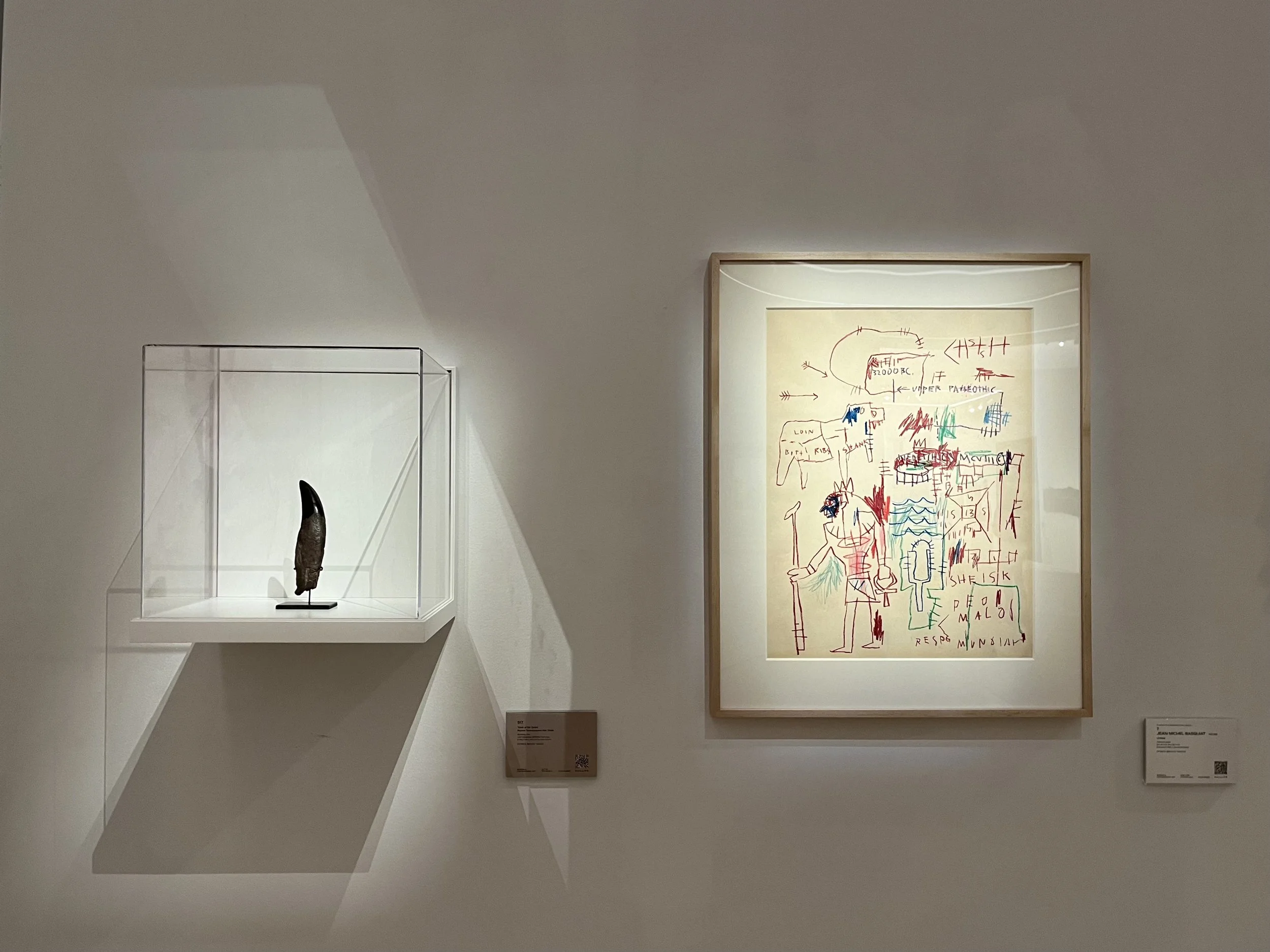
A dinosaur tooth and Basquiat piece placed next to each other / Photo by Mia Lin
Then there was rarity: The invisible backbone of every estimate. A Francis Bacon-inspired piece with his iconic sculptural painting style drew a small, reverent circle of viewers. Bacon’s influence, combined with unusual materiality, created scarcity.
Even the placement of works seemed intentional – a piece of real dinosaur tooth was positioned across from a Basquiat referencing T. rex bones. The pairing was not accidental. Basquiat returned often to prehistoric imagery, and the curators wanted viewers (buyers) to register the thrill of having both the anthropological dread and contemporary mythology sharing a gaze in unison.
As an artist, watching these patterns accumulate unsettled me. In school, I was taught to chase authenticity and originality. But here, in these cathedral-like rooms, creativity felt like it moved through another set of incentives shaped by demand, by resale histories, by trends disguised as destiny. I found myself wondering how many decisions in the studio are made with these pressures half-present in the mind, even unconsciously.
But the auction preview was not only about the artworks. It was about bodies in space, and how people hold themselves around high-value objects. Older collectors leaned in toward brushwork. Young couples walked quickly; catalog PDFs open on their phone. Men in navy suits scanned signatures first, composition second. I began to understand that auctions are their own theater, and that I, a young artist wandering alone, occupied a role whether I accepted it or not.
Walking through the Phillips auction house felt like trespassing at first. But then, slowly, I started asking questions, making small comments and trading observations. A woman next to me murmured something about “post-pandemic palette inflation.” A man nodded when I said I used to study fine arts, as if that explained everything. The fear dissolved into a sharper attentiveness.
Leaving the preview that afternoon, I couldn’t decide whether I felt inspired, disillusioned or simply more aware. Auction season reveals the uneasy pact between art and value, the way creativity and commerce negotiate terms in real time.
When I finally stepped out of Phillips, the air felt colder, louder, less choreographed. The holiday decorations were lit up, and a family was struggling to squeeze themselves into a selfie in front of the display. I offered to take the photo for them, and for a moment I was no longer thinking about rarity, estimates or the market’s strange gravitational pull. I was just part of the sidewalk again, framing a picture not for value, but for memory. After spending the afternoon in rooms where attention is curated and priced, something about that small, ordinary exchange felt grounding. It reminded me that looking begins outside the auction house, in the unpriced world where people simply want to see and be seen.