
Euphoria’s Fashion Enters Its “Adult Era”
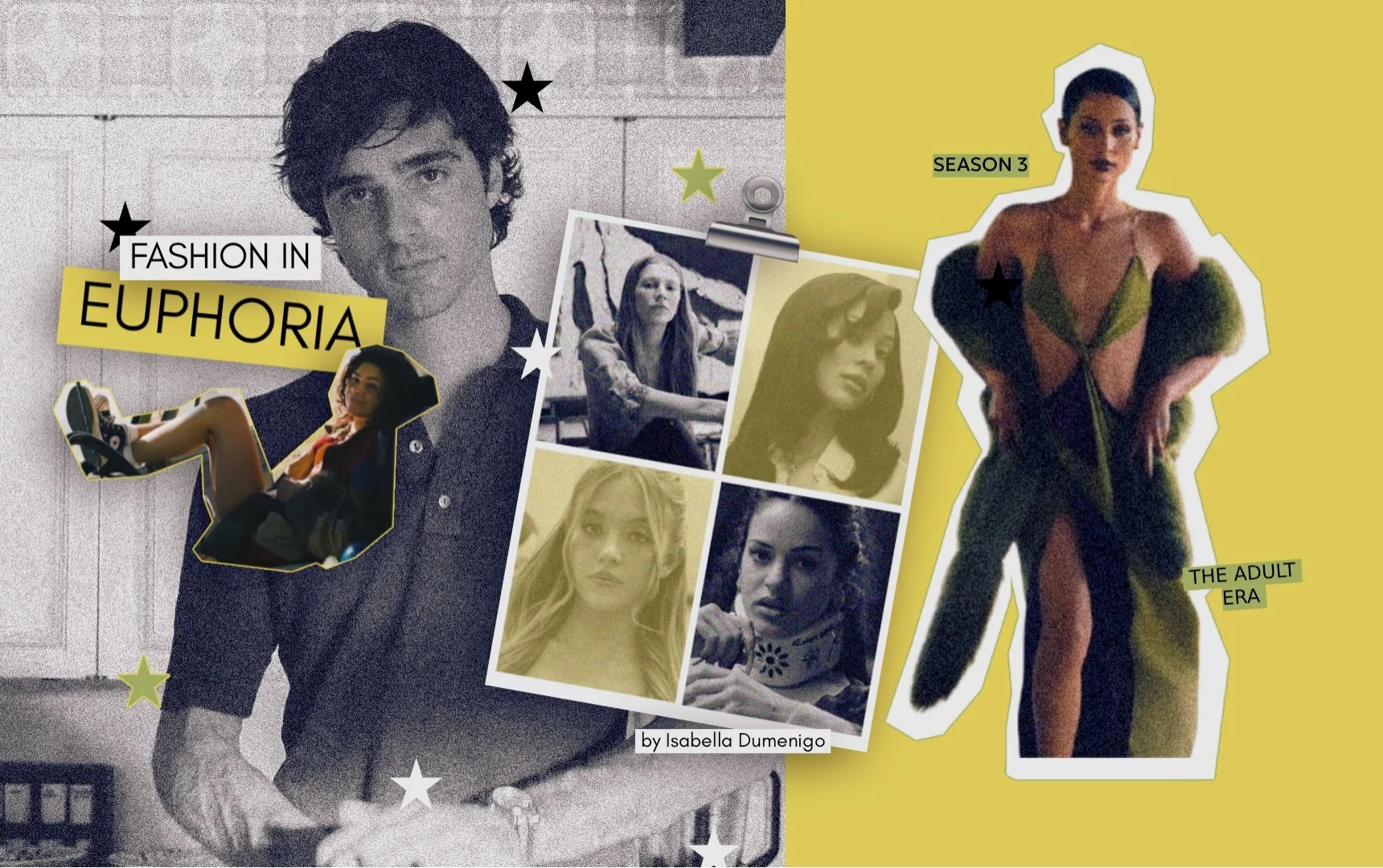
Graphic by Ruhani Koul
No matter how much time has passed, and despite scoops about the problematic behaviors on the show, we always find our way back to “Euphoria.” What initially drew in Gen Z viewers to the iconic hyper-stylized show — the glitter, the moody neon lighting, the dreamlike visuals — now feels increasingly distant. The show has now transformed from the buzzing hallways of high school, charged by drama and gossip, into the early stages of adulthood.
This article breaks down how the characters’ evolving styles mirror their personal journeys. Say goodbye to football jerseys and hello to dad jeans.
Rue, who is known for her baggy silhouettes, knee-length shorts, oversized hoodies, and Converse, still maintains the same style. But her unchanged wardrobe begins to function less as an aesthetic choice and more as narrative stasis.
Her clothing mirrors her central conflict: Rue is still paying for mistakes she made in high school. Now a drug mule, Rue shows little sustained character development, and her appearance reinforces the sense of being stuck. She is visually anchored in adolescence even as her friends and the world around continue to move forward. Time has passed, but Rue’s transformation remains at a standstill.
Maddy, now working in a corporate setting, can no longer rely on the same risky two-piece sets, glitter-heavy makeup, and bodycon cut-outs that once defined her style. Yet even within the constraints of office dress codes, she continues to signal her presence through carefully chosen statement pieces. In the first episode, she appears in a white sheer blazer — a subtle disruption of corporate modesty that still reads as distinctly her. Her makeup, too, remains consistent even as the environment shifts around her.
Experimental looks are no longer appropriate for Maddy’s career, but she maintains her signature cool-toned brown lip liner, nude lipstick, and sharp black winged eyeliner. At the same time, Maddy’s career shift into a more administrative, background role parallels a softening of her once-commanding presence. Still, regardless of her career, Maddy is rarely seen outside of black, and her silhouettes continue to emphasize her body rather than conceal it. Even in corporate America, where everyone seems to work in a blue-grey uniform, her aesthetic insists on visibility.
Cassie, who once desperately tried to become Maddy’s “mini-me” in high school, now seeks attention through a different visual economy: the commodification of desirability for an online audience. Her character, marked by insecurity and a need for validation, never had a defined personal style. Instead, Cassie’s wardrobe has always been curated to appeal to a certain market, choosing clothing not to express identity, but to approximate what she believes will be desired.
In the second season, this meant dressing like Maddie to catch Nate’s attention. Now, leaning into OnlyFans culture where an audience is directly tied to commodified sexuality, Cassie can be seen in an attention-seeking wardrobe — a dog costume, a “baby-doll” look, a wet American flag T-shirt that functions less as character expression and more as calculated outfits to increase audience engagement. Her style is curated for the gaze of others, assigning her value through perception rather than allowing space to explore her own identity or desires.
Newly-engaged Nate, who is now running his father’s construction company, leans into a performance of domestic stability alongside Cassie. His wardrobe now consists of flannels, denim, collared shirts, and straight-leg dad jeans, replacing the athletic gear that once signaled his dominance. Nate also dresses like someone ready to settle down, using clothing to project maturity and control. Where earlier seasons emphasized visible authority through football jerseys and structured sweatshirts, his current style appears softer.
At the same time, Nate’s clothes still gesture toward status. His wardrobe, now reportedly heavy on Bottega Veneta (which actor Jacob Elordi is a brand ambassador for), reinforces an illusion of wealth and status that mirrors the life he is trying to construct, though he is struggling to do so. Nate dresses like a man who has everything figured out, even as his relationships and sense of self remain unstable. His style — much like his engagement — reads less as transformation and more as performance.
Lexi, now working at Warner Bros. Studios as a showrunner’s assistant, shows little shift in her style. Since the early seasons of “Euphoria,” she has been positioned as more self-assured and emotionally grounded than her peers, and her wardrobe has consistently reflected that stability. Collared shirts, checkered patterns, soft pink knits, and fitted cardigans have always defined her look.
Unlike Rue, Lexi’s consistency reads as maturity rather than stagnation. Her outfits have always conveyed poise and control, suggesting someone who understood her direction early on. Now working her way up in production, her style remains composed and deliberate, mirroring her headstrong personality and her growing awareness of her own authority behind the scenes.
Jules, once defined by her playful silhouettes and embrace of color, now leans into a darker, grittier aesthetic. “Euphoria” makeup artist Donni Davy said in an interview with Elle that Jules’ new looks are “more tailored for the male gaze.” Dating guys to make money, Jules has to appeal to an older generation of men. Her silhouette becomes more mature and restrained, distancing her from the youthful, whimsical style that once defined her. Where her earlier looks communicated curiosity and self-exploration, her current styling feels more guarded, shaped by necessity rather than freedom. This transformation hints at a moodier, more conflicted arc in the episodes ahead, with her clothing reflecting a tension between survival and self-expression.
“Euphoria” may have lost its glitter, but it hasn’t lost its edge. Only now, the clothes reveal who's growing up and who's pretending to.